


Choose based on your store’s biggest opportunities—not a feature list.
Every channel is an opportunity: ads create attention, email builds intent—and on your Shopify store, discounts are the opportunity hiding in plain sight. Used with precision, they speed up first purchases, lift AOV, and bring customers back.
Here’s the trap: Blind Discounting. Slapping “WELCOME10” across your site isn’t a strategy—it’s a permanent price cut. It trains shoppers to wait and it burns margin.
This guide turns discounts into a growth engine. We’ll map the opportunities worth targeting, the moments to trigger them, and the best apps to execute—so every offer feels timely, personal, and real.
Where discounts create opportunity (when used right)
Used strategically, discounts unlock five big opportunities: higher conversion rate, bigger AOV, more total revenue, more new customers, and stronger retention. Shopify gives you strong native tools—and the right apps help you capture these opportunities in smarter, more controlled ways. In this guide, you’ll learn each opportunity to target, the best Shopify apps for it, and how to use them effectively.
Four high-impact opportunities (and how to capture them)
| Opportunity | Customer moment | What to deploy |
|---|---|---|
| #1. Turn walk-away visitors into buyers | Add to Cart without Checkout Start | Session-based urgency with single-use code + visible countdown. |
| #2. Win back strategic abandoners | Checkout started (email captured) but no order | Two-step recovery (reminder → final one-time code). |
| #3. Lift AOV on the spot | Mission-focused buyer with one item | Bundles, tiers, spend threshold + Free Gift, in-cart/post-purchase upsells. |
| #4. Build repeat revenue (LTV) | After first purchase | Loyalty + lifecycle flows with smart segments. |
Opportunity #1: Turn “just browsing” into buying (Pleasure Buying)
Signal: Many add to cart; few start checkout.
Psychology: This is Pleasure Buying. In Baymard’s research, ~43% of people who leave without buying say they were “just browsing.” When the purchase isn’t urgent, the default becomes “later.” Your job is to provide a credible reason—and a clear justification—to buy now: a limited, personal saving that feels earned and time-bound.
The play: Catch the browsing high while intent is warm. Trigger a time-limited, single-use offer for walk-away visitors based on signals like long dwell, add-to-cart stall, exit intent, or return visits. Pair the countdown with justification cues (transparent savings, relevant bundle/gift, social proof, easy returns/shipping clarity) near the primary CTA so the shopper can think, “This is a smart decision today.”
Features to demand
- Behavior targeting (only for walk-away visitors).
- One-time, auto-applied codes with real expiry.
- Product & cart countdowns that persist across pages/tabs.
- Justification framing near price/CTA (e.g., “Save $X today,” delivery/returns clarity, reviews).
- Exclusions for protected products/collections.
Best-fit app: Growth Suite — Trigger Campaigns for Pleasure-Buying conversion
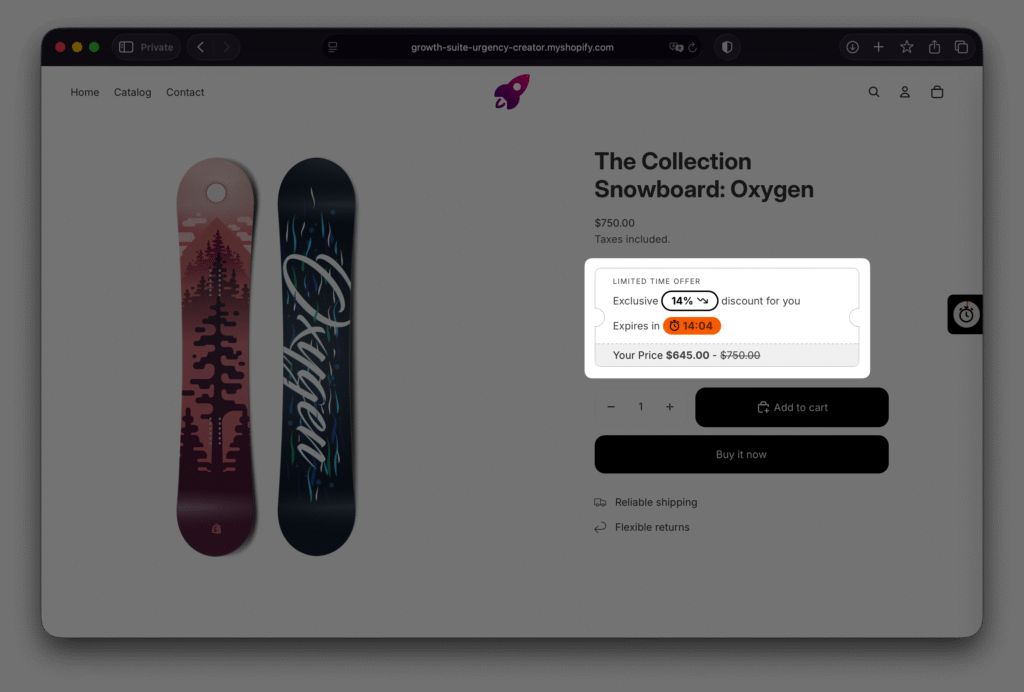
- Walk-away detection. Uses signals (long dwell, add-to-cart stall, exit intent, return visits) to identify “just browsing” shoppers and withholds offers from likely full-price buyers.
- What the shopper sees. A live, session-bound countdown appears on the product page and in the cart drawer; the offer messaging sits near the primary CTA and price (mobile-safe placement).
- Real, one-time code. A unique, single-use code is generated just-in-time, auto-applied to the correct items, respects exclusions, and is revoked on expiry (no reuse or sharing).
- True expiry & sync. Timers persist across tabs and refreshes; when the window closes, the timer disappears and the code is invalidated server-side.
- Justification framing. Clear savings (e.g., “Save $15 today”), delivery/returns clarity, and lightweight social proof help the shopper think, “I already wanted this—if I buy now I save $15; why wait?”
- Brand controls. Set eligible collections/products, floors and caps, cooldown windows, and frequency limits to protect margin and avoid training behavior.
- Measurement. Funnel analytics track add-to-cart → checkout → order lift for exposed vs. control audiences so you can prove incremental revenue.
Opportunity #2: Capture the strategic abandoner
Signal: Checkout started (email captured) but no order.
Psychology: This is often deliberate, not forgetfulness. Shoppers are increasingly coached by the internet (guides, forums, short-videos) and even AI-powered or automated tools to “test for a better deal.” The playbook is simple: add items, enter an email to identify themselves, then intentionally leave—expecting a follow-up discount. Over time, brands that always send a code train customers to abandon, weakening price perception and eroding margin. The opportunity is to control this learned behavior: make the recovery incentive rare, time-bound, and single-use, so waiting doesn’t automatically win and the offer feels credible.
The play: Meet the expectation on your terms
- Reminder, no discount after ~1–2 hours (restate value).
- Final, one-time code after ~24 hours (say it’s the only one—and keep it true).
Features to demand
- Abandoned checkout flows (email/SMS) with timing control.
- Unique, time-limited recovery codes.
- Clear analytics and product exclusions.
Best-fit stack: Shopify Flow + Klaviyo (no storefront app needed)
- In Shopify Flow: Trigger on “Checkout Abandoned,” wait 60–120 minutes, check “Order Placed?” If no, send an event to Klaviyo (or set a tag/variable). After ~24 hours, branch again and fire a Final Offer event only once per customer (use a guard/tag to prevent repeats).
- In Klaviyo: Build a two-step flow: Reminder (no discount) → Final (one-time code). Use unique, time-boxed coupons and auto-expire after redemption or X hours; exclude recent purchasers; apply send-time optimization and SMS fallback.
- Governance: Cap frequency (e.g., 1 recovery code per 30 days), apply product/collection exclusions, and track recovery rate, margin impact, and net lift.
Two-Step Recovery Plan (at a glance)
| Step | Timing | Message | Offer | Guardrails |
|---|---|---|---|---|
| Reminder | +1–2 hours | Value restate, social proof | None | Exclude recent purchasers |
| Final | +24 hours | “Last chance” clarity | Unique, single-use code | 1 per 30 days; exclusions |
Opportunity #3: Grow AOV in the moment
Signal: Orders come in, but baskets are small.
Psychology: Many purchases start as mission-focused or pleasure browsing. When shoppers see an extra value at a spend threshold (e.g., “Spend $60, save $15” or “Spend $75, get X”), it creates a fresh push to add one more item. Offline, you’ve seen this for years: you’re at a cosmetics counter at $62 and the associate says, “At $75 you get the travel set today.” You grab a small add-on to cross the line. The brain frames this as avoiding a loss and as a clean justification: “I already wanted this—if I buy now I save $15; why wait?” Threshold offers are evergreen: they work for first-time and repeat customers across many categories because they give a clear, immediate reason to increase basket size now.
The play: Data-driven thresholding & merchandising
- Analyze AOV by cohort. Split first-order and repeat-order AOV; look at the distribution (median, common clusters), not just the average.
- Pick thresholds just above the cluster. If most first orders sit around $45, test a threshold at $60 (not $100).
- Design value they can justify. Two paths:
- Bundles & tiers: logical multi-buy savings on complementary items.
- Spend-threshold incentive: clear save-$X today or a Free Gift shown transparently.
- Merchandise the path. In the cart drawer, show progress to unlock (e.g., “$12 to unlock…”) and relevant suggestions so one tap crosses the line.
- Make it timely. If you use save-$X or Free Gift, add a short countdown so the reason to act lives in the cart, not just the mind.
- Protect margin. Exclude low-margin/low-stock items, cap discount per order, and set cooldowns.
Features to demand
- Bundles & quantity tiers (e.g., Buy 2 get 10%, Buy 3+ get 15%).
- Spend thresholds with clear, transparent value (save-$X or Free Gift).
- Cart-level progress + relevant suggestions (drawer or mini-cart).
- In-cart and post-purchase upsells.
- Exclusions, caps, cooldowns, and clean analytics.
Best-fit apps
- Kaching Bundles — purpose-built to raise AOV with quantity breaks and bundles. Shows tier tables on the product page, supports variant-aware bundles, applies correct pricing in cart automatically, and offers simple testing/reporting so you can dial in tiers without guesswork.
- Growth Suite — for Free Gift and spend-based incentives without timers. The cart drawer shows progress to unlock (e.g., “$18 to unlock a free gift”), lets shoppers choose from eligible gifts (e.g., X/Y/Z), and, once selected, adds the item to cart at $0 with a clear Gift label. It also recommends contextual products based on past behavior to help cross the threshold. Visible in the cart to all shoppers while the offer is active—no countdown required. Exclusions and eligibility guardrails keep the offer clean and brand-safe.
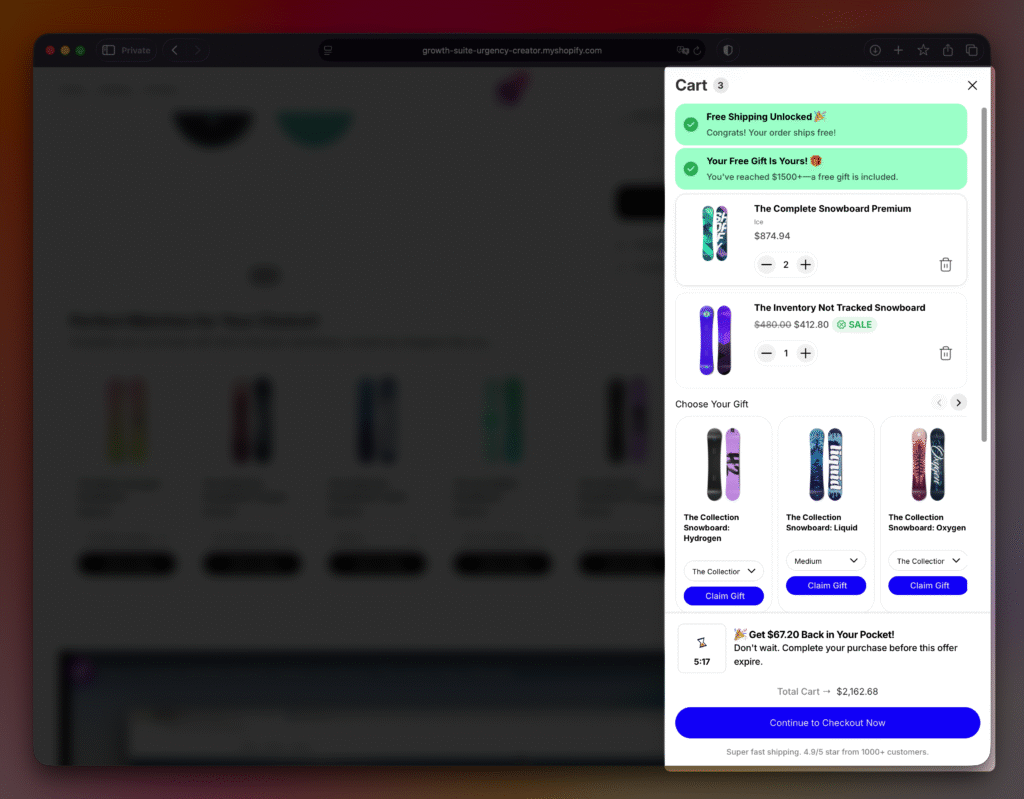
Threshold Selection — Quick Guide
| Cohort | Observed cluster | Test threshold | Why |
|---|---|---|---|
| First-order AOV | $45 | $60 | Close enough to feel attainable; big enough to lift revenue |
| Repeat-order AOV | Use your own data | Cluster + 25–40% | Encourages one more item without feeling out of reach |
Cart Drawer — What to show
| Element | Purpose | Tips |
|---|---|---|
| Progress to unlock | Motivate a small top-up | Always show remaining $ amount |
| Contextual suggestions | Fast path to cross the line | Base on past behavior & basket |
| Gift picker (if enabled) | Visible reward | Show images, specs, “$0 Gift” label |
Opportunity #4: Turn one-time buyers into loyal fans
Signal: Repeat rate is weak; many never return.
Psychology: Most first purchases are transactional—a problem solved, not a relationship formed. After the dopamine of buying fades, three forces push people away: (1) Memory decay (they simply forget you), (2) Friction (re-finding the right item/variant feels hard), and (3) Perceived lack of value (no status, no rewards, no reason to prioritize you over a marketplace). Loyalty programs work because they add status and stakes (VIP tiers), create micro-rewards for engagement, and make re-ordering effortless. For replenishable products (cosmetics, supplements, pet food), the mind looks for a refill cue (“I’m running low”). For non-consumables (fashion, hobbies), buyers respond to complementary looks/kits, seasonal refreshes, and milestone moments (anniversaries, birthdays). Your job: keep the brand in working memory, reduce effort, and make the next purchase feel preferential.
The play (customer buying journey)
- Day 0–3 — Post-purchase nurture (no discount). Thank-you + setup/care tips, size/fit guidance, how-to video, and easy support links. Goal: confidence.
- Day 7–14 — Complementary add-ons. If the item is non-consumable (e.g., apparel, gear), suggest complete-the-look or compatible accessories. If consumable, introduce usage tips and “what customers buy next.”
- Day X — Replenishment window. Map typical use cycles (e.g., 30/45/60 days). Send reorder reminders with the exact item/variant in a one-click checkout link. Offer bundle refills where sensible.
- Milestones & status. Celebrate VIP thresholds, birthdays, and anniversaries; unlock early access or points multipliers. Make benefits clear in the cart and on the account page.
- Win-back (45–90+ days since last order). Start gentle reminders; if still inactive, send a final, single-use incentive with an expiry. Don’t over-train; cap frequency.
Features to demand
- Points & VIP tiers, referrals, bonus actions (reviews, follows, birthdays).
- Segmentation by customer tags, last order date, order count, category purchased.
- Email/SMS lifecycle flows: post-purchase nurture, replenishment, complementary recommendations, win-back, milestones.
- Reorder UX: one-click links, saved variants, dynamic product blocks.
- Governance: earn/burn rules, expiry windows, caps; reporting on repeat rate, CLV, and margin.
Best-fit apps
- Joy Loyalty — Run the loyalty engine: define earn/burn rules, set VIP tiers with clear thresholds and benefits, add referrals and bonus actions (UGC, reviews, birthdays). Enable checkout redemption so points feel tangible. Use expiry windows and tier calendars to maintain momentum. Pass loyalty attributes (tier, points balance, last earn/redeem) into your marketing tool to personalize messages.
- Klaviyo — Orchestrate the lifecycle flows: post-purchase nurture, replenishment schedules aligned to product cycles you define, complementary product recommendations based on prior SKUs, milestone emails, and win-back sequences. Use segments like “First-order in last 14 days,” “90+ days since last order,” “VIP tier = Gold” to tailor cadence and content. Generate unique, one-time coupons where needed; keep others value-led (education, status, early access). Track repeat-rate and CLV lift by segment to prove ROI.
Retention Journey — Cheat Sheet
| Phase | Timing | What to send | Goal |
|---|---|---|---|
| Post-purchase | Day 0–3 | Thank-you, setup/care tips, how-to | Confidence, reduce returns |
| Add-ons | Day 7–14 | Complete-the-look / compatible accessories | Increase AOV on next order |
| Replenishment | Day 30/45/60 | One-click reorder (exact variant) | Boost repeat rate |
| Milestones | Monthly/Annually | VIP tiers, points multipliers, early access | Loyalty & engagement |
| Win-back | 45–90+ days | Gentle nudge → final incentive | Reactivate lapsed buyers |
Best apps by opportunity
- Growth Suite → #1 walk-away→buyer, #3 AOV lift; also seasonal storewide campaigns; unique one-time codes, countdowns, Free Gift, exclusions.
- Shopify Flow → #2 recovery triggers; free, native automation.
- Klaviyo → #2 and #4 retention flows, abandoned checkout, segmentation.
- Kaching Bundles → #3 bundles & tiers to raise AOV.
- Joy Loyalty → #4 points, VIP, referrals for repeat revenue.
App Selection — Summary Table
| App | Primary opportunity | What it’s best at |
|---|---|---|
| Growth Suite | #1, #3 | Behavior-based offers, one-time codes, countdowns, Free Gift in cart |
| Shopify Flow | #2 | Native automation & triggers (e.g., Checkout Abandoned) |
| Klaviyo | #2, #4 | Email/SMS lifecycle flows & segmentation |
| Kaching Bundles | #3 | Bundles, quantity tiers, simple testing/reporting |
| Joy Loyalty | #4 | Points, VIP tiers, referrals, checkout redemption |
Your 6-point checklist (before you install)
- Site speed: Does it load asynchronously? Test before/after with PageSpeed.
- Success metrics per opportunity: CR (O1), recovery rate (O2), AOV (O3), repeat rate/CLV (O4), plus margin.
- Free trial: At least 7–14 days with the features you need.
- Onboarding & support: Ask a pre-sales question. How fast/clear is the reply?
- Ease of use: Look for no-code setup and recent reviews on setup.
- UX & branding: Test mobile. Ensure widgets never hide Add to Cart.
Common mistakes to avoid
- Blind Discounting (WELCOME10 forever). That’s a price cut, not a growth plan.
- Gimmick wheels. Often over-discount shoppers who would buy anyway.
- Copying competitors. Your opportunities are unique—diagnose first.
- Chasing “free.” The cost of not capturing the opportunity is usually higher.
Conclusion
Discounts work—when they’re targeted and time-bound. If an offer has no end, most shoppers delay.
Growth Suite stands out because it combines AI-guided on-site countdowns and single-use codes with storewide campaigns and clean discount management (auto-created codes, exclusions, real expiry). Use it to convert walk-away visitors, lift AOV with Free Gifts, and protect margins. Then add Shopify Flow, Klaviyo, Kaching Bundles, and Joy Loyalty where each fits.
You’re not buying an app—you’re choosing a repeatable, margin-safe opportunity strategy for 2025.
